The Story of a Walleye: From Egg to Trophy
 This is the story of a single walleye. We’ll call her Goldie. She is not one real fish, but her life follows the same path as millions of walleye in the lakes and rivers of North America, and every stage of it is based on how walleye actually live and grow.
Knowing that story helps explain a lot of what anglers see on the water: why walleye gather on rocky shoals in spring, why they bite best at dusk, why they move to different depths through the year, and why so many anglers choose to release the big females. So let’s start at the very beginning, on a cold spring night just after the ice went out.
Spring: an egg on the rocks
Goldie’s story began in early spring, shortly after the ice melted. The water was still cold, around 45°F (7°C). For several nights, adult walleye had been gathering near the shallow areas where they spawn every year. Some lived in the main lake and moved onto wind-swept gravel shoals. Others swam up a nearby river to rocky stretches with moving water.
Walleye spawn at night. In the dark, the males arrived first and waited over the rocks. Then the larger females came in. Goldie’s mother swam close to the bottom with several males beside her, and released thousands of eggs while the males released milt at the same time.
Walleye don’t build nests and don’t guard their eggs. Once spawning was over, the adults simply returned to deeper water to recover and feed.
The eggs were sticky at first, then hardened and drifted down into the gaps between the rocks. There, moving water and waves kept them clean and supplied with oxygen. It was a dangerous place to begin life. Fish, birds and insects ate many eggs. Silt settled on others and smothered them. A sudden cold snap or a storm could destroy many more. Out of thousands of eggs, only a small share would ever hatch. Goldie’s egg was one of the lucky few.
The first weeks: tiny and hungry
After two to three weeks, depending on the water temperature, Goldie hatched. She was smaller than a grain of rice, almost transparent, and carried a small yolk sac attached to her body. For a few days she lived on the food stored in that sac, drifting with the current.
When the yolk sac was used up, she had to find food. She began feeding on zooplankton, the tiny animals that drift in open water. This is a critical time for young walleye. If there isn’t enough zooplankton at the right moment, many young fish starve. That spring, conditions were good.
Summer: growing fast
Through the summer Goldie grew quickly. She moved from zooplankton to insect larvae, then to small fish. By the end of her first summer she was several inches long.
Life was dangerous. Many young walleye became food for pike, bass, perch and older walleye. Birds such as cormorants and herons took others from the shallows. Goldie survived by staying near cover and feeding in low light, when predators found her harder to see.
Eyes built for the dark
Goldie had a special advantage that would serve her for her whole life. Walleye eyes contain a reflective layer called the tapetum lucidum, which bounces light back through the eye and helps them see well in dim, murky water. It is also why their eyes seem to glow silver when light hits them, and it is how the walleye got its name.
Goldie learned to hunt at dawn, at dusk and at night, when smaller fish couldn’t see her coming. On cloudy, windy days, when waves broke up the light, she often hunted during the day as well.
Years of slow growth
In northern waters, walleye grow slowly because the growing season is short and the water is cold for much of the year. By three or four years old, Goldie was around 12 to 15 inches long. Female walleye grow larger and live longer than males, and at about five or six years old she joined the other adults on the spawning rocks for the first time.
A year in the life of an adult walleye
Once she was an adult, Goldie followed the same pattern every year.
Goldie’s neighbors: the food web under the water
Goldie never lived alone. Her life was tied to many other creatures in the lake, and changes to any of them affected her.
Biologists call years with many surviving young fish “strong year classes.” A single strong year can provide good fishing on a lake for many seasons, as those fish grow up together.
How biologists know Goldie’s age
Fisheries biologists can tell how old a walleye is in a similar way to counting the rings of a tree. Fish grow fast in summer and slowly in winter, and this leaves rings in their scales and in small ear bones called otoliths. By counting the rings, biologists learn the age of each fish, how fast walleye grow in a lake, and how many survive each year. This information helps them set size limits and seasons, and decide whether a lake needs stocking.
In many lakes, wildlife agencies also raise young walleye in hatcheries and release them to support the population. Walleye are so popular that they are the state fish of Minnesota and South Dakota.
A trophy fish
Goldie lived for more than 15 years and grew past 28 inches, a true trophy. Every spring she returned to the same rocks and released many thousands of eggs, far more than when she was young, because larger females produce many more eggs than smaller ones.
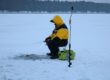
One winter evening, an angler caught her through the ice. He admired her for a few seconds, took a single photo, and slipped her back down the hole. He knew that big females like Goldie are vital to the future of the lake.
What Goldie can teach anglers
Frequently asked questions
How long do walleye live?
In northern waters, walleye can live for 15 to 20 years or more. In warmer, southern waters they grow faster but usually live shorter lives.
How many eggs does a female walleye lay?
It depends on her size. Large females can produce well over 100,000 eggs in a single spawning season.
Do walleye spawn in the same place every year?
Many walleye return to the same spawning areas year after year.
Gear for walleye: ice fishing gear, nets, hard lures.
Posted November 2026.